Introduction
The Kart a Helice project was a semester long project I got to work on during my first year at the BUT GEII. In teams of 6-8 students, we were tasked with creating a remote controlled propeller kart following industry standard project management. We learned to produce product design documentation, to present progress to clients through review meetings and to produce verification certification of our prototype to certify the validity of the product.
First-year BUT GEII contributor in a 6-8 student team creating a remote controlled propeller kart.
Follow a specification provided by professors while using industry-style project management and reviews.
Product design documentation, review presentations, and verification certification for the prototype.
Chapter 01
Design
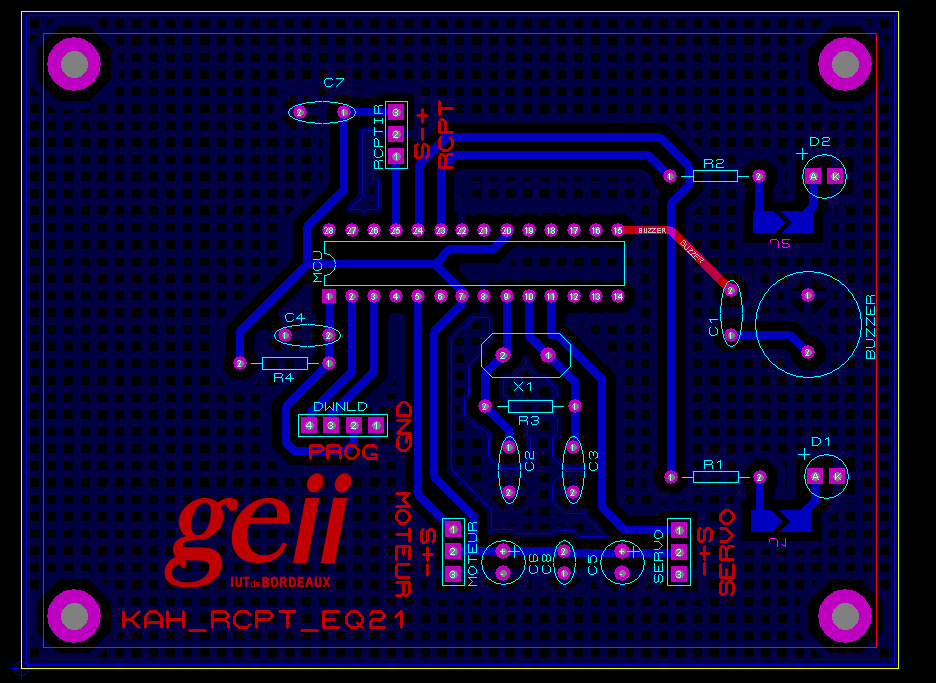
As part of the project design phase I was tasked with the creation of the acquisition and action blocks of the reception device for the kart. Furthermore, I had to select the right components and size them so the prototype could fit a specification provided by our professors.
I designed the IR reception block, the brushless motor and servo control logics for thrust and direction, two LED assemblies to signal power state of the electronics and whether we were receiving valid data from the receptor and finally a horn block made with a buzzer we were supposed to ring at a precise frequency.
Once we were finished with our design we had to fill a compliance matrix to explain how our solution was respecting the specification, explaining in detail our calculations and product selection, this was all logged in a product design document. We used this document to produce a preliminary design presentation, much like we would have to in a real industrial setting.
Download design fileChapter 02
Verification
After the design and manufacture phases, we had to produce quantifiable verifications of the prototypes and verify whether the solutions we outlined actually fit the specification.
I was tasked with verifying proper power output for the kart's remote controller to guarantee a good range, analysing digital NEC frames to make sure we were sending the right commands but also measuring mechanical dimensions of the prototype to make sure the PCB wasn't too big or measuring an LED brightness.
I really appreciated the professional simulation setting we were being put under, at every phase of the project we had set deliverables and milestones. For the verification we were once again asked to submit a verification compliance matrix to ensure the prototype fitted the specification and we presented our findings to a teacher during the verification review meeting.
Download verification file